Beatbot · Review
Beatbot Sora 10 Review: The Honest Budget Pool Robot
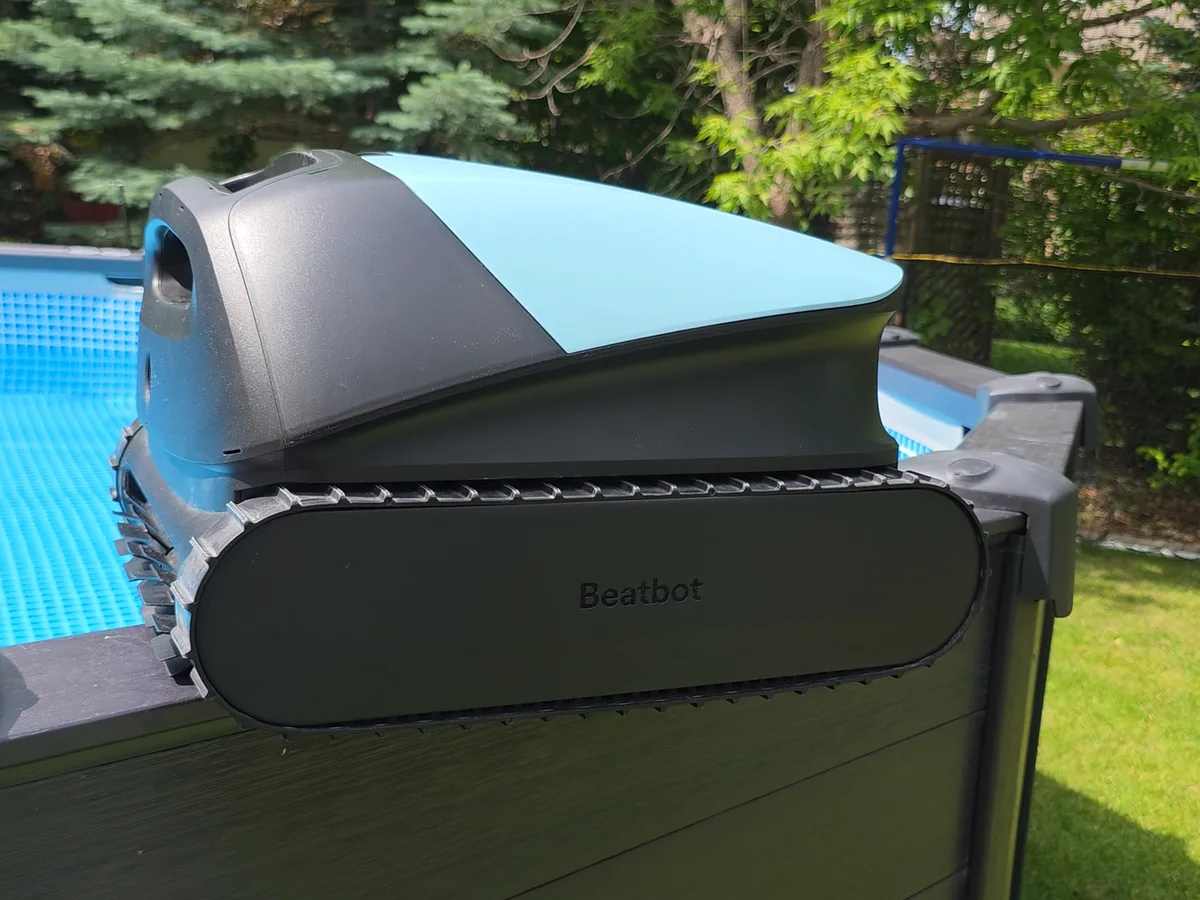
Heads up: Some links on this page are affiliate links. If you buy through them, I may earn a small commission at no extra cost to you. I only recommend gear I'd actually use. Full disclosure.
I test pool gear the way a busy dad with two kids and a pool actually uses it. Beatbot sent me the Sora 10 — the cheapest cordless robot in their lineup — as a paid partnership: they covered the product and the coverage, the verdict is mine. My test pool is a standard 15-foot round above-ground pool, 48 inches deep — nothing fancy, and well under the 3,229 sq ft the Sora 10 is rated to cover. This testing doesn’t stress that coverage claim, and I’m not going to pretend it does. I ran the robot for four weeks — about six full cleaning cycles — before writing any of this.
What it actually picked up
The basket is the most convincing part of this robot, and it’s not close. Over four weeks it pulled the usual leaves and sand out of the pool, run after run, with no clogging. It also came up with a kids’ Minion toy and 1-inch pebbles. One time, I threw a 5-inch diving retrieval ring into the pool myself and forgot about it — found it in the basket the next time I checked the robot. That’s a solid object, not loose debris, and that’s what 6,800 GPH of suction means in practice. (The ring catch isn’t in the video — it happened off camera — but it happened.) Fine material — pollen, silt — does pass straight through the 150-micron mesh, but that’s the mesh doing exactly what a 150-micron mesh is built to do, not a defect in the unit.
Walls and waterline: the real surprise
This is the part that outperformed what I expected for the price: it climbs and cleans the walls and the waterline well. That’s usually where budget robots fall down, and this one didn’t.
Waterline parking runs longer than the spec says
Beatbot’s own spec says it holds at the waterline for about 10 minutes after a cycle, ready to grab. Over six cycles, mine held closer to 20 minutes before it sank back down. That’s my own repeated observation, not a number off a spec sheet, and it cuts in your favor — but only if you know it. You get a real window to grab it at the wall; miss that window and you’re retrieving it off the bottom instead.
Clear water isn’t this robot’s job
My pool looks clean right now, and I want to be direct about why: that’s my filter and my pool chemicals doing that work, not the Sora 10. This robot moves debris — leaves, sand, toys, whatever’s on the floor. It was never going to deliver clarity on its own, and it doesn’t. If you’re buying a robot expecting it to be the reason your water looks clear, you’re buying the wrong product — that’s your filtration system’s job, robot or not.
Other things worth knowing
The app disconnects the moment the robot submerges, so any “smart” control only exists at the surface, before or after a cycle — that’s true of any Wi-Fi-connected underwater robot, not a flaw specific to this one. It also needs about 12 inches of water depth to operate, so it won’t reach a shallow top step.
What I’m not claiming yet
One thing stays open rather than guessed at: I didn’t time the runtime myself — it appeared to complete a full cycle each time across six runs, but I’m not putting a number on that. The runtime and charge-time figures in the specs above are sourced to Beatbot’s own claims, not my stopwatch.
Who it’s for — and who should skip it
This is the pick for a standard in-ground or above-ground pool with a mostly flat floor, where the goal is hands-off cleaning at a fraction of premium-tier cost. It’s not the pick if you’ve got a multi-level pool, heavy fine-debris conditions, or you need lab-clear water — the mesh size rules that out regardless of how well the robot drives, and clarity was never its job to begin with.
How it compares
I’ve also been running Beatbot’s own AquaSense 2, the premium cordless robot I’ve also tested, and the price gap is the whole story: the AquaSense 2 runs over $2,500 — more than five times the Sora 10’s roughly $500. Here’s what that premium actually buys.
On retrieval, the Sora 10 is the easier lift: 19.0 lb dry against the AquaSense 2’s 28.2 lb, both weighed on my own scale, and I pull the Sora 10 out one-handed at the waterline. To be fair, hauling either one out of an above-ground wall while it’s dripping wet takes some grip — someone with less hand strength might want two hands on the Sora 10 too, and some days I can hardly pull the AquaSense 2 out at all.
Both apps drop connection the moment their robot submerges — that’s physics, not a flaw specific to the Sora 10. But the AquaSense 2 floats when a cycle finishes, so it stays on the surface and controllable and I can check its battery right away. Convenient. The Sora 10 holds at the waterline for about 20 minutes, then sinks — a real window, not an indefinite one.
Filtration is genuinely a tossup. The AquaSense 2 runs a two-basket mesh system and might catch marginally more fine material, but the Sora 10’s suction is strong enough that I’m not willing to call a winner here.
Navigation is the one place the price gap is unambiguous: the Sora 10 has no mapping and wanders, while the AquaSense 2 maps the pool and runs a back-and-forth route, with more app customization and more sensors behind it.
Put together: five times the money buys mapping, a floating finish at the end of a cycle, and more app control. It does not clearly buy cleaner water. That’s the finding.
If cordless convenience matters less than price, the WYBOT C1 is another budget-minded cordless robot worth a look, and the Efurden handheld covers spot-cleaning for less than either robot. The full Pool Vacuums roundup lines all of these up side by side.
Bottom line
Four weeks and six cycles in, the basket tells the story better than the spec sheet does: it hasn’t clogged once, and it’s pulled up things a spec sheet never accounts for — a kid’s toy, pebbles, a retrieval ring I tossed in myself. It climbs walls and waterlines better than its price suggests it should, and against Beatbot’s own $2,500+ AquaSense 2, the honest finding is that five times the money buys mapping and convenience, not clearer water. Runtime and charge time are still sourced to spec, not my stopwatch, but everything else here is what I actually saw over a month of real use. This is a paid partnership with Beatbot — they covered the product and the coverage, but the verdict is mine.
What I like
- Around $500 (US) — genuinely the budget entry point to real cordless cleaning, versus $2,500+ for Beatbot's own premium robot
- 19.0 lb dry with waterline parking — easy one-handed lift-out
- Truly cordless: drop it in, walk away, come back to a clean floor
- Handles leaves, sand, and even solid objects (pebbles, a dropped toy) without clogging
- Climbs walls and scrubs the waterline grime ring — outperformed expectations for the price
What to know
- 150-micron mesh lets fine silt and pollen through — not for glass-clear water
- No mapping — wanders rather than following a set route
- App goes offline underwater — the 'smart' control is really just start/stop from the deck, and unlike some cordless robots it doesn't float to the surface when done
- Won't clean the top step (needs about 12 in of water depth)
↑ Comparing options? See the full Best Pool Vacuums roundup.
Frequently asked questions
Is the Beatbot Sora 10 fully cordless?
Yes — charge it, drop it in the pool, and it runs with no cable to manage. That's the whole appeal versus a corded robot or a booster-pump system.
Will the Sora 10 leave my pool perfectly clear?
No, and it isn't designed to. It moves debris off the floor, walls, and waterline; water clarity is the job of your filter and pool chemicals. Its 150-micron mesh also lets fine particles like pollen and silt pass through by design.